Naplen

AI software factory · fractional principal engineer · four-time founder

Ship faster with AI your team can trust.

I tighten how your team builds with AI, and my agentic software factory delivers features at a pace a team can't match alone, still tested and secure.

See the results

I have made production systems faster and carried them at scale.

Companies I have worked with

Dapper Labs
NBA
Staging Labs
Laliga
uPlexa

Previously founded and scaled multiple products including Staging Labs (acquired), Crypto-Loot, ArtlyCart, and uPlexa. Additionally, I have worked with teams at Dapper Labs, Integral, TeraGo Networks, and Deloitte on performance-critical systems.

AI made every engineer faster. It did not make everyone a 10x engineer.

A 10x engineer was always the one who works ten times more efficiently than the average engineer. Now every engineer has AI, and the average has moved with it.

So the bar moved too: you still have to be ten times more effective than an average engineer who has AI. I get there with a software factory engineered around how I work, and every change it makes is reviewed before it reaches you.

On one platform project, my output roughly tripled once I built the factory

Merge requests merged per week on one platform project, before the factory
13.5
Merge requests merged per week on one platform project, with the factory
39.3
Merge requests merged by ISO week, 2026-W30 to 2026-W44Stacked bars, one per ISO week drawn, 14 weeks from W30 to W44. 272 merge requests merged in total, 157 opened by my software factory and 115 opened by hand. The factory starts opening merge requests in W37. The peak is 62 in W44. One week with no merge requests, time off, is not drawn. ISO week of 2026
  • Opened by my software factory
  • Opened by hand
Merge requests merged by ISO week, 2026-W30 to 2026-W44
WeekOpened by my software factoryOpened by handTotal
2026-W30044
2026-W3101212
2026-W32099
2026-W3301414
2026-W3401212
2026-W3502020
2026-W3601414
2026-W37718
2026-W38527
2026-W396915
2026-W4023124
2026-W4125530
2026-W4336541
2026-W4455762
Total157115272

Merge requests merged in each ISO week, 2026-W30 to 2026-W44 on one infrastructure-heavy platform project, split into those opened by my software factory under my account and those opened by hand. One week of time off with none merged is not drawn.

These figures come from one infrastructure-heavy platform project with complex tickets: integration and infrastructure work, where each change is harder than a typical application change. They are not from all my projects. A merged merge request is a unit of reviewed change, not a measure of effort. Factory-opened is inferred from the factory branch prefix under my account. The project has no history before July 2026.

Source: one infrastructure-heavy platform project, as of 2026-11-04.

A software factory turns senior judgment into throughput.

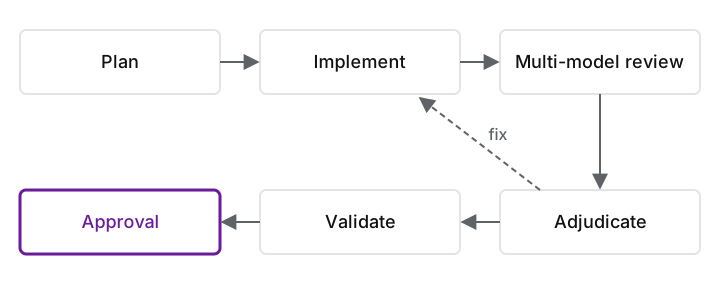
Flow of the factory: plan, implement, multi-model review, adjudicate, validate, approval, with fixes returning from adjudication to implementation.
Work moves from plan to approval; confirmed review findings return to implementation.

You get my judgment on

  • Architecture
  • Review
  • What is ready to ship

The factory does

  • Plans the work
  • Implements it
  • Reviews it with independent models
  • Adjudicates the findings
  • Validates against the plan
Review findings confirmed against the code
1,812
Review rounds per ticket, on average
1.47
Reviewed tickets that passed in one round
372 of 475

Source: the review ledgers of my software factory

How the managed factory works

I work where systems break.

I’m usually brought in when the stakes are high: real users, real money, and systems that can’t afford to break.

Managed engineering factory

Your roadmap delivered as reviewed pull requests

I integrate my software factory into your repositories and tune it to your architecture and review rules, so you get pull requests that fit how your team works.

667

Tickets merged by my software factory since 2026-08-19, across five projects, mostly its own development

See the factory

AI forward deployed engineering

AI agents that work against your real systems and data

I embed in your problem and build the agents, orchestration and MCP integrations it needs.

The result is running software your team owns, not a strategy deck and not a generic chatbot.

How forward deployed work runs

Backend and platform engineering

Platforms that hold up when the load arrives

Distributed systems, infrastructure as code, and the platform work underneath them.

76%

Of merge requests merged touch infrastructure as code

See the platform work

Financial systems and blockchain

Trading and blockchain systems where latency costs money

Market infrastructure, Solana and EVM infrastructure, and smart contracts built for correctness first.

99.7%

Staging Labs: reduction in execution time

See the financial systems work

Security automation

Agents that probe like an attacker, findings an engineer has checked

Agentic red-teaming: autonomous agents probe your system the way an attacker would, and an engineer reviews every finding before it reaches you.

Every finding is checked by an engineer before it reaches you.

How the security review works

Workflow review · where engagements start

A concrete plan before you commit to more

How your team ships today, where AI and my factory fit, and the security issues worth fixing first.

One review of how your team ships, a concrete plan, and you decide whether to continue.

How a workflow review works

I have seen systems break at every scale.

  • Scalability

    A system scales as far as the resource its parts share, so I find that resource and measure time spent waiting for it apart from time spent working.

  • Distributed Systems

    Most failures in a distributed system happen between its parts rather than inside them, so I design for what each part does when another one goes quiet, answers late or reaches for the same state.

  • Enterprise Systems

    An enterprise system is held together by its controls, so I make each merge gate read the evidence it claims to read and give each person and service only the access its current work needs.

  • Moving Fast

    When work moves fast, an approved plan is wrong in small factual ways by the time it is built. The fast path that stays correct is a builder who checks each premise against the code, keeps the plan’s intent, and writes down every place the plan was wrong and why.

  • Human in the Loop

    A person in the loop is a throughput dependency, not only a safeguard. When every hold on landing work waits for that person, an autonomous system stops landing anything and looks healthy while it does, so it has to report what landed and what is waiting on someone.

  • Founder Experience

    I have founded products and hired a team of engineers to grow one, and running them meant decisions engineering does not answer: who the product answers to, the smallest version people can try, whether they use it and pay for it, and what a no should trigger.

An engagement starts with a workflow review and asks less of your team at each stage.

I help crypto and TradFi teams design and ship production systems that can scale without rewrites, firefighting, or hidden technical debt.

  1. 1

    Workflow review: I find where AI and my factory move your team faster

    I look at how work moves through your team today, from ticket to production: where AI helps, what my software factory can take on, how to configure it for your codebase, and the security issues I find along the way. You leave with a plan either way. From you: access to your repositories and CI, and a walkthrough of how your team ships.

  2. 2

    Onboarding: one to two weeks setting the factory up with your team

    I set the factory up in your repositories and tune it to your architecture, conventions and review rules. This is when I work most closely with your team, agreeing how work reaches the factory and how its changes come back for review. From you: your conventions, your review rules, and the people who know them.

  3. 3

    Steady state: your roadmap arrives as reviewed pull requests

    The factory plans, builds and reviews work from your roadmap, and each change reaches you as a reviewed pull request. You get architecture direction from me. From you: priorities, and sign-off where your approval workflows ask for it.

Start with a workflow review.

One review of how your team ships, a concrete plan, and you decide whether to continue.

[email protected]